
The Number That Made the House Feel Personal
I already knew the house leaked. The baseline energy audit had made that clear. What I did not expect was how it would feel to watch the manometer settle on a final number while the big fan roared in the front doorway.
6.8 ACH50.
For anyone who does not live in airtightness numbers, that means the entire volume of air inside the house was being replaced nearly seven times per hour under the test pressure. A reasonably tight modern house aims for half that or better. High-performance new construction often lands under 1.5. My ordinary 2003 subdivision house was performing like a building that had never been asked to keep its air to itself.
I stood there with the auditor, looked at the infrared camera images blooming with cold streaks at the top plates and rim joists, and felt the peculiar mix of embarrassment and determination that only a former network engineer can produce when a system he lives inside fails a basic diagnostic.
This is the story of that test, the emotional hit, and the practical work that followed. The number broke my spirit for about twenty minutes. Then it became the most useful data the house had ever given me.
Your house should work for you, not the other way around. Sometimes it has to tell you, bluntly, that it is not doing so yet.
Why the Blower Door Still Matters More Than Most Upgrades
You can install the best heat pump on the market and still waste a large fraction of its output if the envelope is leaky. You can add solar and watch a meaningful slice of the production disappear through gaps you cannot see. Air leakage is not dramatic. It is continuous, invisible, and expensive.
The blower-door test quantifies it. The infrared camera and smoke pencil show you where. Together they turn a vague suspicion into a prioritized punch list. That is why I scheduled the test even after the first round of utility-bill analysis. Bills tell you the total. The fan tells you the mechanism.
The Test Day Itself
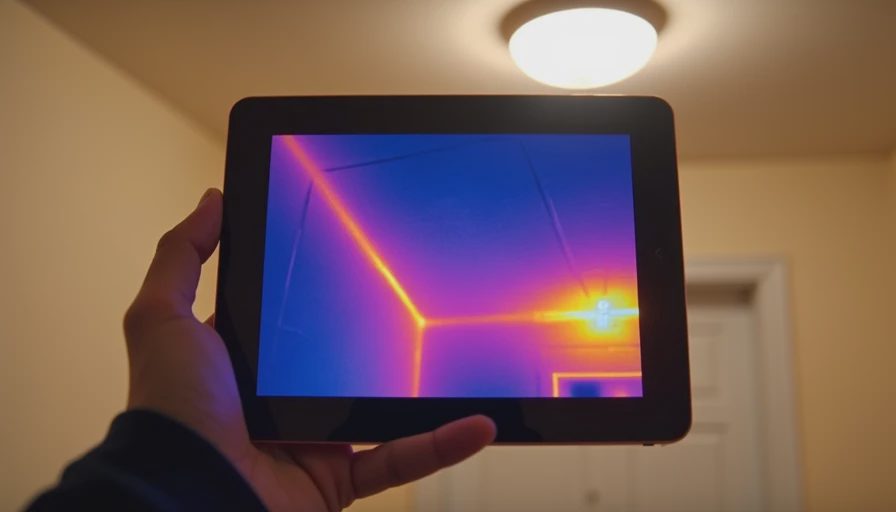
The auditor sealed the house, closed every interior door that needed closing, and ramped the fan until the pressure difference hit 50 Pascals. The manometer did its work. The number appeared. Then we walked.
Infrared showed cold air washing down the exterior walls at the top plates—classic missing or compressed insulation at the wall-to-ceiling junction. The rim joists at the foundation level lit up like a Christmas tree. The attic hatch, the can lights in the upstairs hallway, and the penetrations around the plumbing stack were all active leak sites. A few electrical outlets on exterior walls contributed their small share.
None of it was exotic. It was simply the cumulative result of 2003 builder-grade detailing that met code at the time and never claimed to be anything more. The house had been performing exactly as designed. The design just was not interested in airtightness.
From Discouragement to a Workable Plan
The emotional reaction lasted long enough for one cup of coffee and a short rant about “how did anyone think this was finished.” Then the engineer brain reasserted itself. A clear list of leaks is a gift. It is finite. It can be ordered by impact and difficulty.
We started with the biggest volumes: attic air sealing at the top plates and penetrations, followed by rim-joist insulation and sealing from the basement side. The attic hatch received a proper insulated cover and gasket. Can lights that penetrated the ceiling plane were either sealed or replaced with airtight versions. A handful of obvious exterior-wall penetrations were caulked and foamed from inside.
I did not try to reach Passive House numbers. I aimed for meaningful improvement that a homeowner could actually complete without dismantling the house. After the first major sealing pass we retested. The new number landed at 4.1 ACH50. Still not elite, but a 40 percent reduction in leakage area. The difference was already noticeable in how evenly the heat pump maintained temperature and how much less the system had to run during windy cold nights.
What the Improved Envelope Changed Downstream
Every later upgrade became more effective. The heat pump no longer had to fight a constant stream of outdoor air. The circuit-level data showed cleaner, more predictable heating loads. Comfort improved in the previously cold upstairs bedrooms without raising the thermostat. When solar eventually arrived, a larger fraction of the generation stayed inside the thermal boundary instead of heating the neighborhood.
The blower-door result also changed how I talk to other homeowners. I no longer start with equipment. I start with the question: do you know how tight the box is? If the answer is no, the first useful step is measurement, not shopping.
Practical Advice If You Are About to Face Your Own Number
Hire someone who will walk the house with you and explain the camera images in plain language. The number alone is not enough; you need the locations.
Expect ordinary houses from the 1990s–2010s to land between 5 and 10 ACH50 unless someone has already done serious sealing work. You are not uniquely failed.
Prioritize large, accessible leaks first. Attic plane, rim joists, and big penetrations move the needle faster than chasing every outlet gasket.
Retest after the major work. The second number is what tells you the effort was real.
Finally, give yourself permission to feel briefly terrible when the first result appears. Then put the feeling down and pick up the foam gun. The house is not judging you. It is simply reporting its current state.
The Quiet Aftermath
The house is still not perfect. It does not need to be. It is noticeably tighter, more comfortable, and more responsive to every efficiency measure that came after. The original 6.8 ACH50 no longer feels like a verdict. It feels like the starting coordinate on a map we actually used.
I still have the test report in a folder. On days when a new upgrade is tempting me to skip the boring envelope work, I open it. The number that once broke my spirit now keeps the projects honest.
Your house should work for you, not the other way around. Sometimes the most useful thing it can do is tell you, clearly, where it is failing—so you can finally fix it.



Letters
No letters yet — be the first to write.